An AD&D 2e Revised Campaign Setting
The Endless Manse
A Campaign Sourcebook
Draft 0.2 - July 28, 2026
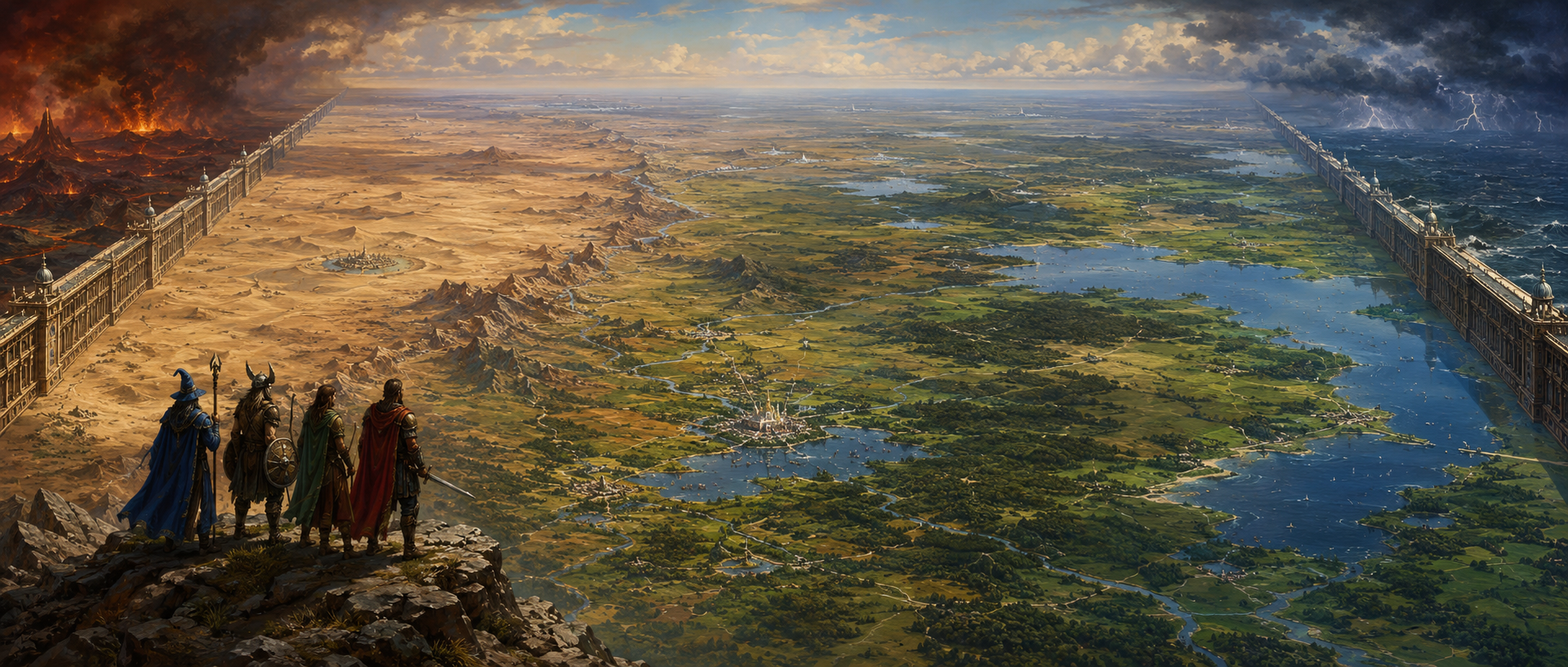
A thousand years ago, a wild surge turned a wizard's magnificent mansion into a world. Its walls rose into mountain ranges and its ponds widened into seas. Everyone who lives here is a guest, a guest's descendant, or something twisted from a servant the house made.
Contents
Player-facing chapters describe the world as its inhabitants know it. Chapters marked for the Dungeon Master appear only in the DM edition of this book.
1. The Shape of the World
The world is a room. Even those who have never seen its edges know that it ends at the Walls: four ranges of sheer white stone, hundreds of miles apart, whose peaks vanish above the weather. No one has crossed them. According to the oldest histories, no one built them. A thousand years ago, a wizard miscast a spell of shelter. Wild magic surged, and the mansion he meant to raise for one night became a demiplane that has grown ever since.
1.1 The Walls
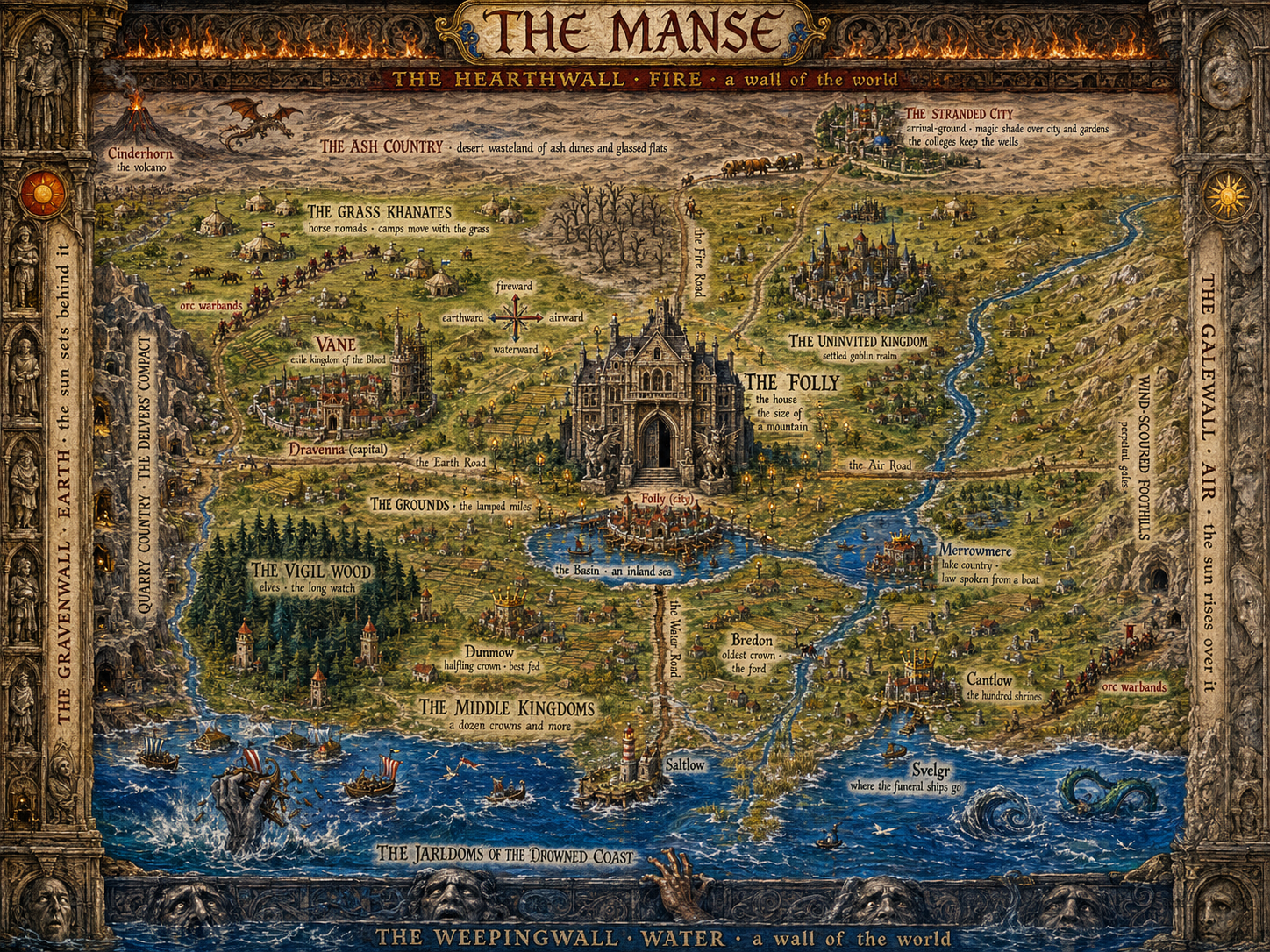
Each Wall borders a different elemental plane which shapes the nearby country. Ash storms blow from the Hearthwall. The sea country beneath the Weepingwall never dries. Endless wind scours the Galewall's foothills. At the Gravenwall's roots, miners trade with creatures of living stone.
The border countries are wider than the old surveys record. Borderfolk point to farms three generations old that now stand a day's walk farther from the Wall than their deeds describe. Everyone else dismisses this as borderfolk exaggeration.
1.2 The Folly
The world's largest city takes its name from the mountain above it. The Folly's upper slopes still show courses of masonry, window rows the size of canyons, and a portico no road reaches. Scholars say the name recalls the Founder's folly, the miscast that made the world. Townsfolk say it describes anyone who tries to climb the mountain.
Near the ground, the Folly stops pretending to be a mountain. Its lowest reaches are a manor's first storey built at the scale of cliffs: porches deep enough to shelter villages, window bays glazed in panes the size of millponds, service doors that whole streets now run through, and the Folly Gates themselves: two leaves of grey timber taller than the weather, bound in black iron and studded with rivets the size of houses, with carved panels broad enough to farm. The Griffons flank the Gates on plinths. They are stone gate-beasts of the kind any manor might set at its gateposts, each as large as a hill fort. Everyone agrees they are stone. The Gates remain ajar exactly as they stood at the Founding. Between them, a tall wedge of darkness opens wide enough for a wagon at the threshold and narrows to a hairline far above. It has never widened or closed.
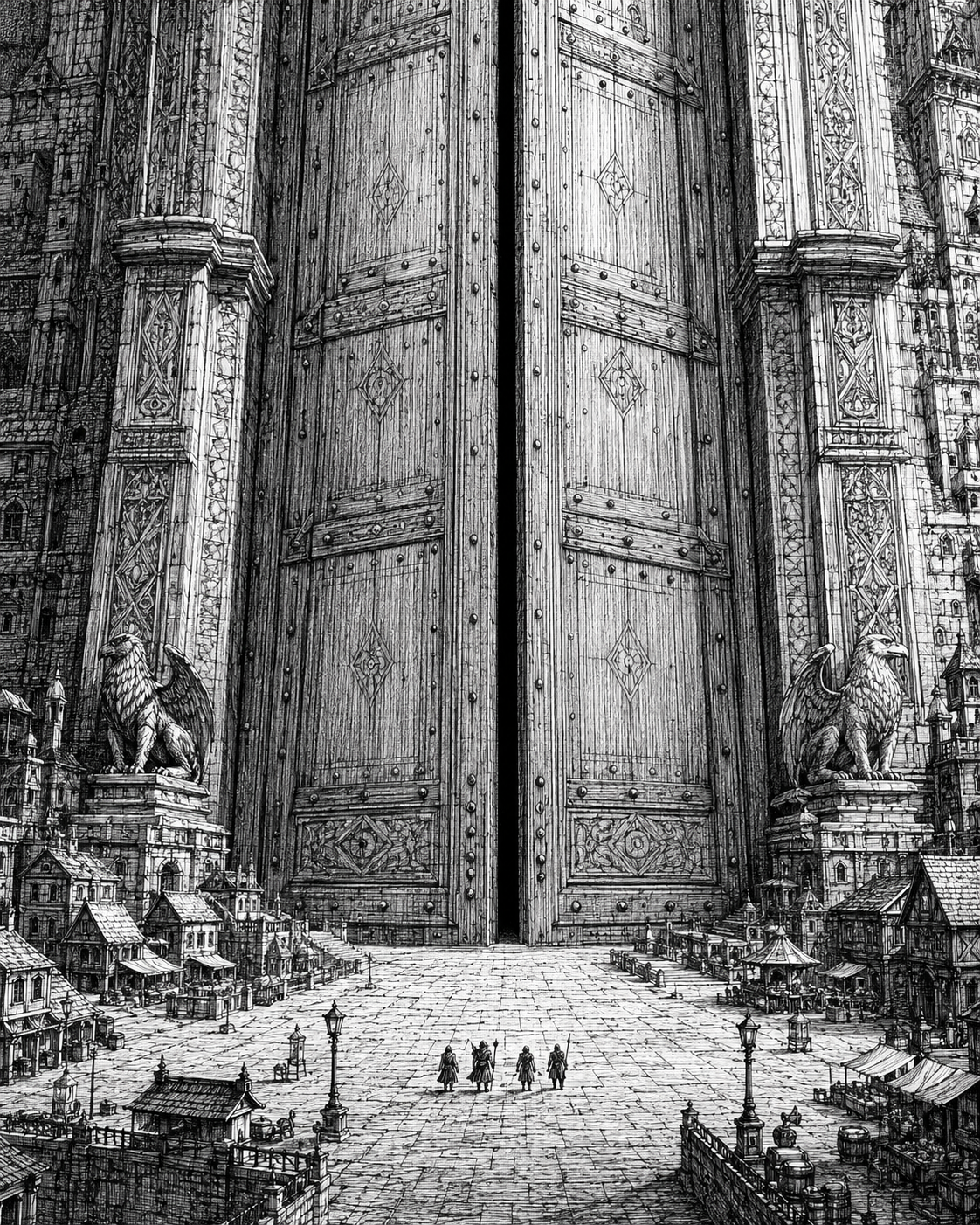
The Gates are only the grandest of many. Dozens of house-sized doors pierce the mountain's base: service doors, garden doors, and doors whose purpose no one can guess. The busiest is the Wicket, beside the Gates. Though its arch could hold a cathedral, the Gates dwarf it. Nearly all lawful traffic into the mountain passes beneath it. A sculpted face watches from above the arch. The city calls it the Porter. No one has seen it move, and no two engravings agree on its expression.
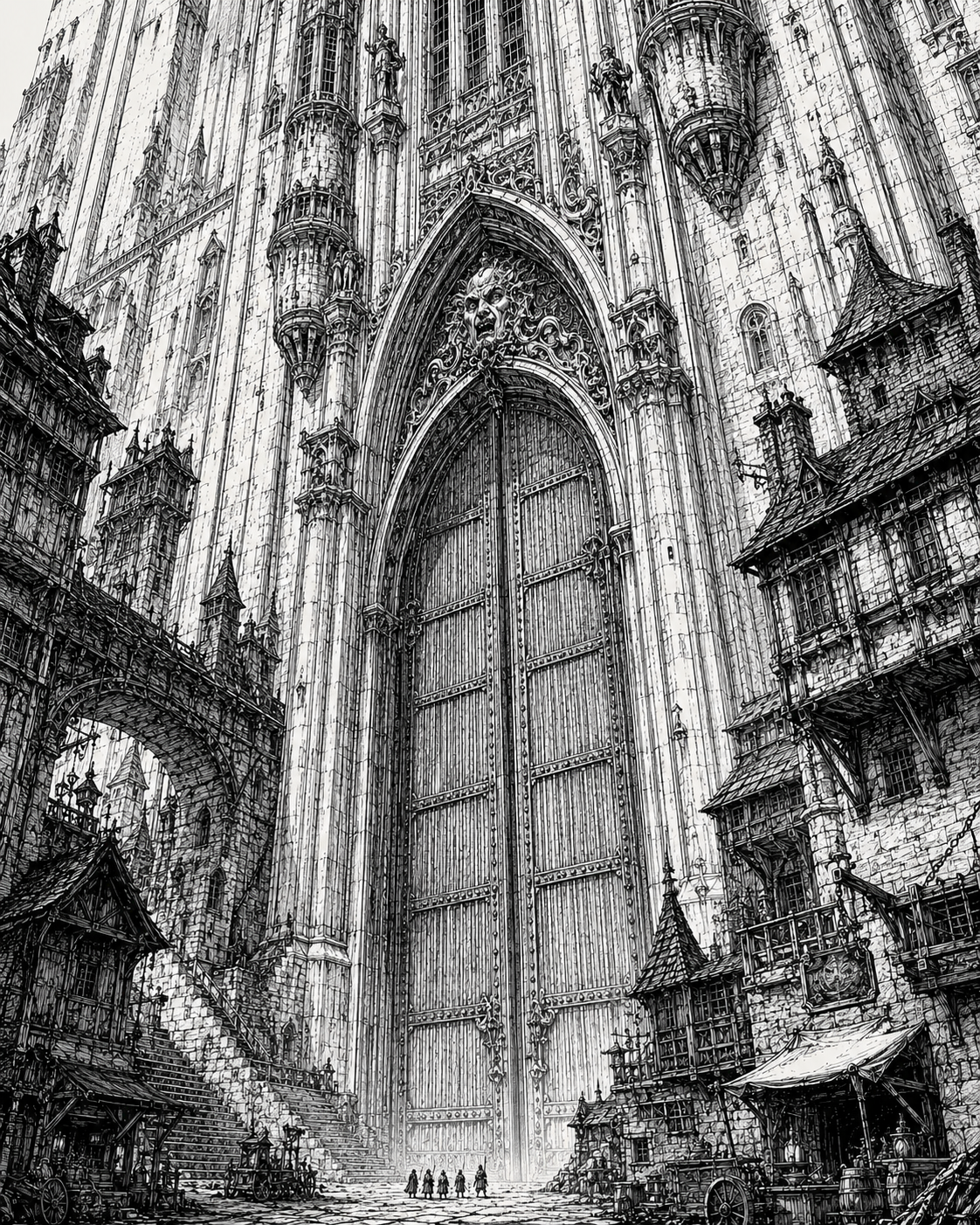
Humbler still are the cut gates, passages carved through the living stone by miners, guilds, and impatient neighborhoods. They never last. A passage cut in a grandmother's day becomes a crawlspace in her grandchild's and a sealed seam a lifetime later. The cutting trades keep count, and keep cutting. Only the house's own doors keep their size.
The ground level is the richest larder in the world. In many halls, the old magic still keeps house. Sideboards laid for guests a thousand years dead are full again each morning. Bread stays warm, casks never empty, and ballroom instruments strike up when someone crosses the threshold. Provisioners run scheduled routes to reliable rooms. A pantry-run is respectable work and, by Folly's standards, fairly safe: the ground floor usually tolerates courteous guests.
The upper floors are another matter. Their stairs climb into unmapped country rich with unclaimed luggage, plate set for banquets never held, and gifts still wrapped for hosts who never came down. The wild surge also changed the servants caught above the first landing. Things in their livery still walk the high corridors, stripped of their old patience. Worse tenants have moved in since. Expedition companies post their wills before they climb. They return rich or not at all. Folly uses the same saying for both: the Folly keeps its guests.
The city of Folly grew from the mountain's gatehouse and never stopped. Its districts, government, and defenses are described in chapter 3. Every people of the Manse keeps a quarter there, and every institution that claims to remember the Founding keeps a hall. It is called the City of Lamps. During the ember half of the year, the mountain's shadow crosses the city at noon. Bells ring in the Noon Dark, and lamps burn through half an hour of borrowed dusk while the fields beyond the gates remain bright. Then the bells ring it out again (see the Mountain Clock).
A glazed turret crowns the summit. Old surveys call it the Lantern. Some nights, though no calendar predicts them, a light shines there. Follyfolk toast its appearance. No one climbs to ask who lit it.
1.3 The Peoples
Four broad lineages share the world. The Housebound descend from the adventurers trapped at the Founding. The Drawn arrived over the centuries, plane-walkers pulled off course by the Manse's wild magic. The Borderfolk migrated in from the elemental planes beyond the Walls. And the Staff evolved from the magical servants who once tended the mansion: peoples of animate porcelain, linen, brass, and candleflame who no longer answer to anyone.
2. The Sky and the Year
The sky of the Manse keeps perfect books. The sun rises in the same place each morning. The year runs to the day. Nothing in the heavens has ever drifted, hurried, or fallen behind. Scholars find this more unsettling than reassuring.
2.1 The Sun's Road
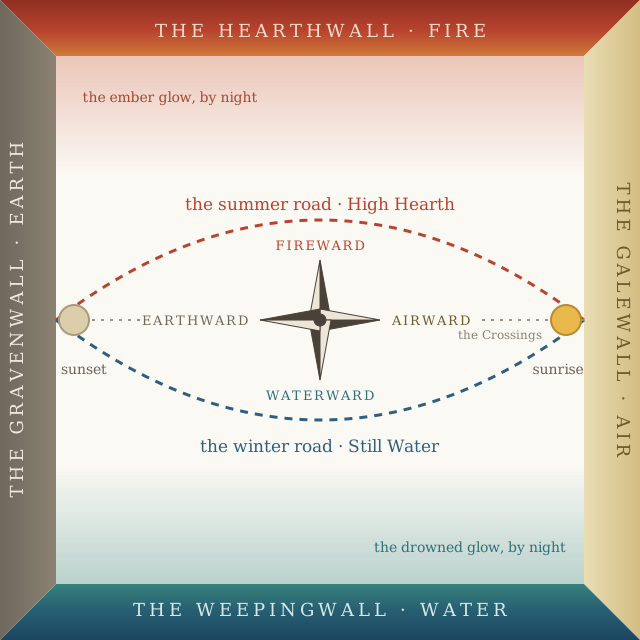
The sun rises over the Galewall and sets behind the Gravenwall. Anyone can watch its journey between. What happens after sunset is either a childish question or a blasphemous one, depending on whom you ask. The sun simply appears above the Galewall the next morning, as it has for a thousand years.
The sun's road shifts through the year like a slow pendulum. In the warm months, its arc leans toward the Hearthwall. At High Hearth, the summer sun-stand, it passes closest to the fire. In the cold months, it leans toward the Weepingwall. At Still Water, it follows the far edge of the sky above the sea country. Winter days are no shorter than summer days; the sun is merely farther away. Its pale, slanted light gives the borderfolk their name for the season: lamplight weather.
2.2 The Night Skies
Night in the Manse is never wholly dark, and it has two colors. Above the Hearthwall the sky glows red and orange, like banked coals seen through smoke; the glow brightens and dims with the ash storms but never goes out. Above the Weepingwall the sky answers in blue and green, the shifting, layered light of a sun seen from under deep water. Between the two glows the high sky is black.
No traveler in the Manse is ever lost at night. Face the embers, and the drowned light is at your back; morning will rise on your right hand, and the sun will set on your left.
2.3 The Compass
The Manse has no north. Directions are taken from the four Walls, and common speech uses them two ways:
- Traveling, one goes fireward, waterward, airward, or earthward: "three days' ride fireward of Folly," "the moss grows on the waterward side of every tree."
- Naming, the bare element serves as the direction itself, the way a road or a gate carries it: the Fire Road leaves Folly by the Fire Gate, the water quarter floods in spring, and the ember half of the year is hot.
Mapmakers draw fire at the top of the sheet. The ember glow, they say, is the night sky's brightest beacon and the surest point from which to hang a map. The drowned glow is beautiful but inconstant.
2.4 The Mountain Clock
The Folly is the largest sundial ever built, though no one built it. Its shadow falls earthward at dawn, wheels across the country, and points airward by dusk. Every town and field within sight of the mountain tells time by its arrival. "The shadow's on the orchards" is as precise as any clock, and the calendar in a border-country almanac is as valid one year as the next.
The noon shadow is the seasonal hand. During the ember half of the year, the leaning sun throws it waterward across the city. This is the Noon Dark, longest at High Hearth. During the drowned half, the shadow swings fireward, and villages on the mountain's other flank receive their own brief winter dusks. On the two hinge days when the sun passes directly overhead, the shadow shrinks to the mountain's roots and Folly keeps its lamps cold at noon.
2.5 The Year
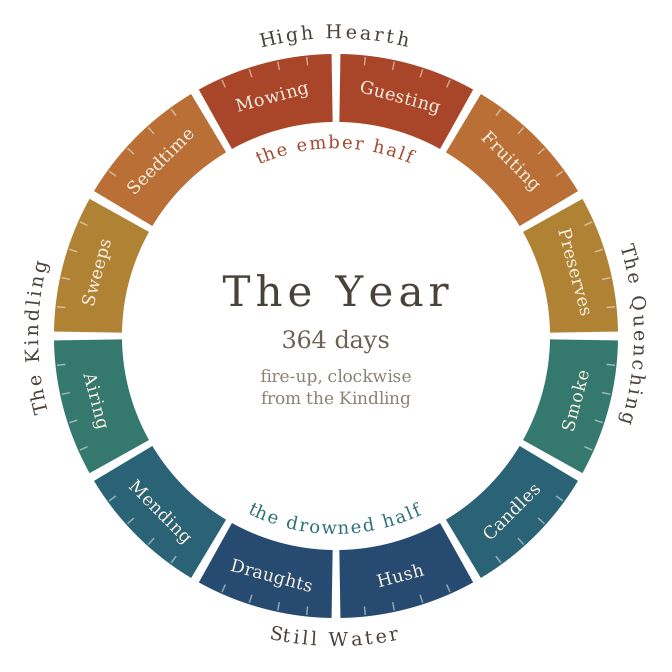
The year is one full swing of the sun's road: exactly 364 days, with no leap days and no drift. It divides into an ember half and a drowned half, joined by four hinge days that belong to no month or week:
- The Kindling: the sun crosses the centerline of the sky heading fireward. The year begins; in Folly they say the year is lit.
- High Hearth: the summer sun-stand, when the sun's road passes nearest the Hearthwall. The longest, hottest light of the year, and the longest Noon Dark in the city.
- The Quenching: the sun crosses back. Harvest fairs, debts settled, fires raked out and relaid.
- Still Water: the winter sun-stand, when the sun walks the far edge of the sky above the sea country. The palest light of the year.
2.6 Months and Weeks
Each half of the year holds six thirty-day months. Their names come from the mansion's old calendar of chores. The Staff kept those names alive long after the house outgrew the work, and no one has managed to replace them.
| Month | Half | Named for |
|---|---|---|
| The Kindling | hinge (New Year) | the sun crosses fireward; the year is lit |
| 1. Sweeps | Ember | chimneys swept and the great spring cleaning |
| 2. Seedtime | Ember | planting of the grounds |
| 3. Mowing | Ember | first hay of the year |
| High Hearth | hinge | the summer sun-stand at the Hearthwall |
| 4. Guesting | Ember | the old season for receiving guests |
| 5. Fruiting | Ember | the orchards |
| 6. Preserves | Ember | bottling, pickling, and jam |
| The Quenching | hinge | the sun crosses waterward; fires raked and relaid |
| 7. Smoke | Drowned | meat smoked and chimneys relit |
| 8. Candles | Drowned | the dim months' candle-making |
| 9. Hush | Drowned | the deep cold, when sound carries far |
| Still Water | hinge | the winter sun-stand above the sea country |
| 10. Draughts | Drowned | cold wind walking the halls |
| 11. Mending | Drowned | indoor work; linens and harness mended |
| 12. Airing | Drowned | rooms thrown open ahead of spring |
The six-day week is another remnant of the service rota. Five weeks make a month:
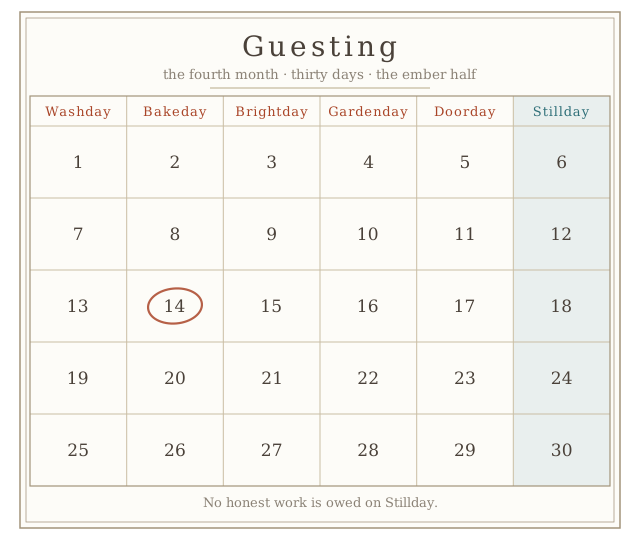
Washday, Bakeday, Brightday (when the brass and silver were polished), Gardenday, Doorday (markets, callers, and errands; the day the door was answered), and Stillday, when the house lay still. Stillday is the common day of rest; the hinge days stand outside the week entirely, and no honest work is owed on them.

Dates are written plainly: 14 Guesting, Doorday, 29 Hush. Years are counted from the Founding, though the oldest institutions differ by a few decades and each keeps its own reckoning.
3. Folly, the Free City
Folly is the world's largest city and the only city known across most of it. It descends the Folly's waterward flank from the gate square to the Basin. A wall rings the city, though beside the mountain's architecture it looks like a garden border. Its ends are mortared into the Folly itself, so wall and mountain close the circle.
The city wall is low, stout, and pierced by four gates named for their roads: the Fire Gate, Water Gate, Air Gate, and Earth Gate. No siege has tested it, nor was it built to stop an army. A city beside doors no one can close sleeps better behind one of its own. The Pantry's hearth-count and the institutions' censuses disagree over the population, as they do over every count in the Manse. All agree that Folly holds more people than every border-country town combined.
3.1 The Guest Right
Folly calls itself a Free City and has never needed an army to prove it. Its freedom rests on the Guest Right, the world's oldest legal doctrine: every soul within the Walls is a guest of the same absent Host, and no guest may set themselves above another under that Host's roof. A crown, the city's judges reason, does exactly that. Thus Folly has no lord and never has. Its officers hold household posts in the Host's absence and answer only to the peace of the house. Follyfolk put it more plainly: nobody rules Folly. Folly is kept.
Border-country lawyers call the Guest Right a fable dressed as a statute. Perhaps it is. No army has tested it. Follyfolk explain why with a proverb: you do not storm a house through its gate lodge while the owner is upstairs.
3.2 The Table
The Table governs from Trestle Hall in the Parterre. The seven districts, three great companies—the Provisioners, the cutting trades, and the registered expedition companies—and four peoples each hold a seat. One chair stands empty at the head for the Host. The minutes open each sitting with the Host's apologies for absence. By long custom, the Table cannot vote while anyone stands behind the empty chair. More than one famous vote has turned on that rule.
The Table chooses the Housekeeper of Folly, the city's first officer, who serves until the Table chooses a successor. The Housekeeper presides at Trestle Hall, keeps the keys to the four wall gates, commands the watches, and speaks for the city. Members of every people have held the office. Staff candidates are traditionally the hardest to unseat, since, their supporters argue, they were made to keep house.
The Pantry, led by the Pantler, holds the city's purse. It collects the Grounds' board, the wagon-penny at the wall gates, the Provisioners' charter-rents, and the climb-tithe at its Gateyards counter. Its unbroken ledgers predate the institutions' own histories, a fact those institutions resent.
Judges called Ushers dispense justice at the Doorcourt in the old gate lodge, the city's first building. The court does not hang. Its harshest sentence is to be shown out: struck from the hearth-count and escorted past the last lamp. Follyfolk consider this worse than hanging. The roads from Folly are long, and the lamps do not follow them far.
3.3 The Districts
The city stands on the guest house's gardens, whose old plan remains visible beneath the streets. Each district inherits one feature of the grounds. The older the district, the more closely its streets follow the planting beds.
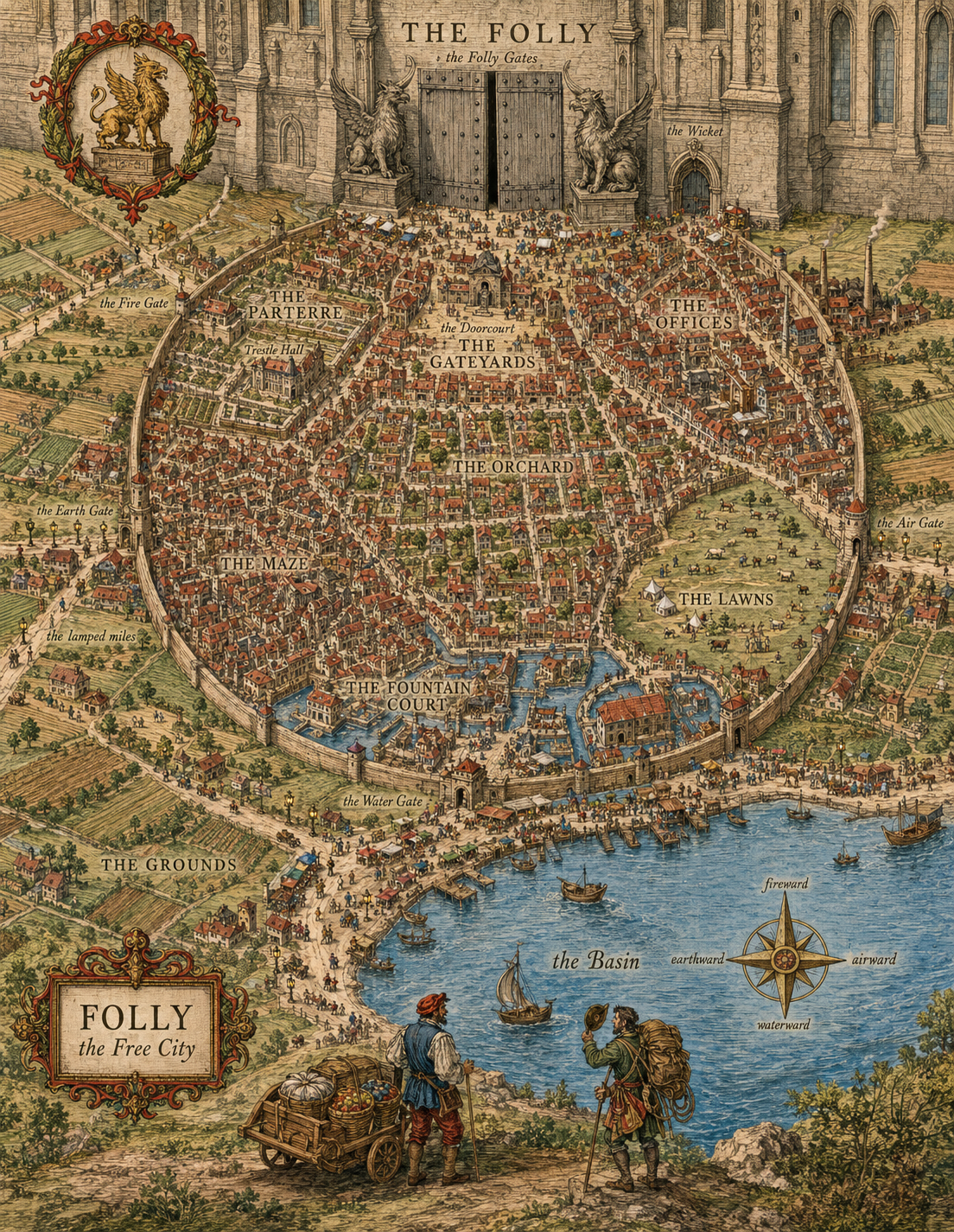
- The Gateyards. The oldest district grew from the gate market that still crowds the Wicket's jambs. It holds outfitters, Provisioners' halls, the Pantry's assay counter, the hiring steps where expedition companies post their bills, and the Doorwatch barracks. Ground is priced by the yard and let by the width of a shopfront.
- The Parterre. On these formal terraces above the gate square, streets run straight and cross at right angles because the flowerbeds did. Here stand Trestle Hall, the counting houses, the halls of institutions that claim to remember the Founding, and the homes of the oldest Housebound families.
- The Fountain Court. The house still feeds the fountains of this low waterward district. Their water is clean, constant, and slightly too cold. Canals carry it past laundries, dyers, and fish markets. Each spring, the Court floods to its doorsteps and holds regattas in the streets. Sea-country Borderfolk keep their quarter here. Outside the Water Gate lies the Basin, an ornamental pond grown into a small inland sea. Docks line its shore beneath the wall, ferries serve the Grounds' waterward villages, and its catch fills the markets.
- The Orchard. The guest house's fruit trees still grow in these walled closes. Some bear out of season, and one or two out of reason. Food markets cluster here, and the Fruiting fair fills the district for one week each year.
- The Maze. The old hedge maze survives in narrow, doubling streets that look unhelpfully alike. Addresses are strings of turns, not names. Rents are low, the district asks few questions, and the Lampwatch patrols in pairs. Maze-born children learn left and right long before fireward and waterward.
- The Offices. The Staff quarter bears the name a great house gives its service rooms. Here, peoples of porcelain, linen, brass, and candleflame keep the world's finest workshops and observe the old household calendar most strictly. In the Offices, Brightday still smells of polish.
- The Lawns. These commons slope from the city's airward edge into the Grounds. They hold livestock fairs, drying grounds, the Muster's review field, and the tents of new arrivals. The city has always let newcomers camp there, mostly because stopping them costs more than it saves.
The four peoples keep quarters rather than walled enclaves. Cookery and calendars, not gates, mark these neighborhoods within the districts. Only the Offices comes close to belonging to one people outright.
3.4 The Grounds and the Board
The Free City's writ extends beyond its wall. Around Folly lie the Grounds: farms, orchards, mills, and quarries bound to the city by ledger, road, and lamplight. The Pantry raises lamp-posts along the great roads, and one rule serves as law: the Grounds go where the lamps go. The lamps now reach about three days down each road and a little farther every generation. When traffic justifies another lamp, the Pantry adds one. It has never taken one down.
In the week after each hinge day, the Grounds pay the board. The Pantry assesses each village in coin or kind, and mounted Reeves collect it. In return, the city provides lamps and oil, road wardens, access to its markets and courts, and shelter behind the wall when needed. Each village keeps its own headman and small court. A Reeve's saddlebag carries the ledger, not the law.
3.5 The Lamps, the Doors, and the Muster
The city keeps its peace with three bodies, in rising order of steel.
The Lampwatch serves as constables and lamplighters, which Follyfolk consider one duty: light and order arrive together. Watch patrols carry hooked poles and short cudgels. They ring the Noon Dark in and out and call the hour in the Maze, where visitors cannot otherwise tell it.
The Doorwatch holds the Gateyards. Paid from the climb-tithe and recruited from expedition veterans, it faces the mountain rather than the city. Its members register climbs at the Pantry's counter, order the Wicket queue, watch the lesser doors, and man the door-bells in the Gateyards' towers. No bell has rung in earnest within living memory. Ballads tell of earlier ringings, but the ballads disagree.
The Muster is everyone else. Every householder in the city or Grounds owes six drill days a year. District rotas ensure no trade stands idle at once, and district halls store the pikes and crossbows. In the week after the Quenching, the whole Muster assembles on the Lawns for review. The Table names a Marshal for the day, the only purpose the office has served in living memory. Folly has never faced a siege. The Muster credits its drills. Everyone else credits the neighbors' good sense.
3.6 The Coin of the House
Folly strikes its own coin at the Pantry's mint behind the Gateyards assay counter. Its metal comes down the mountain: candlesticks, salvers, and plate from banquets never held, carried through the Wicket, weighed, tithed, melted, and struck. The city has no mines and has never missed them. Ask where the coin in your pocket spent the century before last, and a Folly merchant will answer, upstairs.
| Coin | Value | Face |
|---|---|---|
| Spark (q) | ¼ stub | a stub, quartered along the roads |
| Half (h) | ½ stub | a stub, halved |
| Stub (cp) | 1 cp | the Wicket, with the Porter above the arch |
| Lamp (sp) | 10 stubs | a road lamp, lit |
| Griffon (gp) | 10 lamps | a Griffon on its plinth |
| Gate (pp) | 10 griffons | the Folly Gates, ajar |
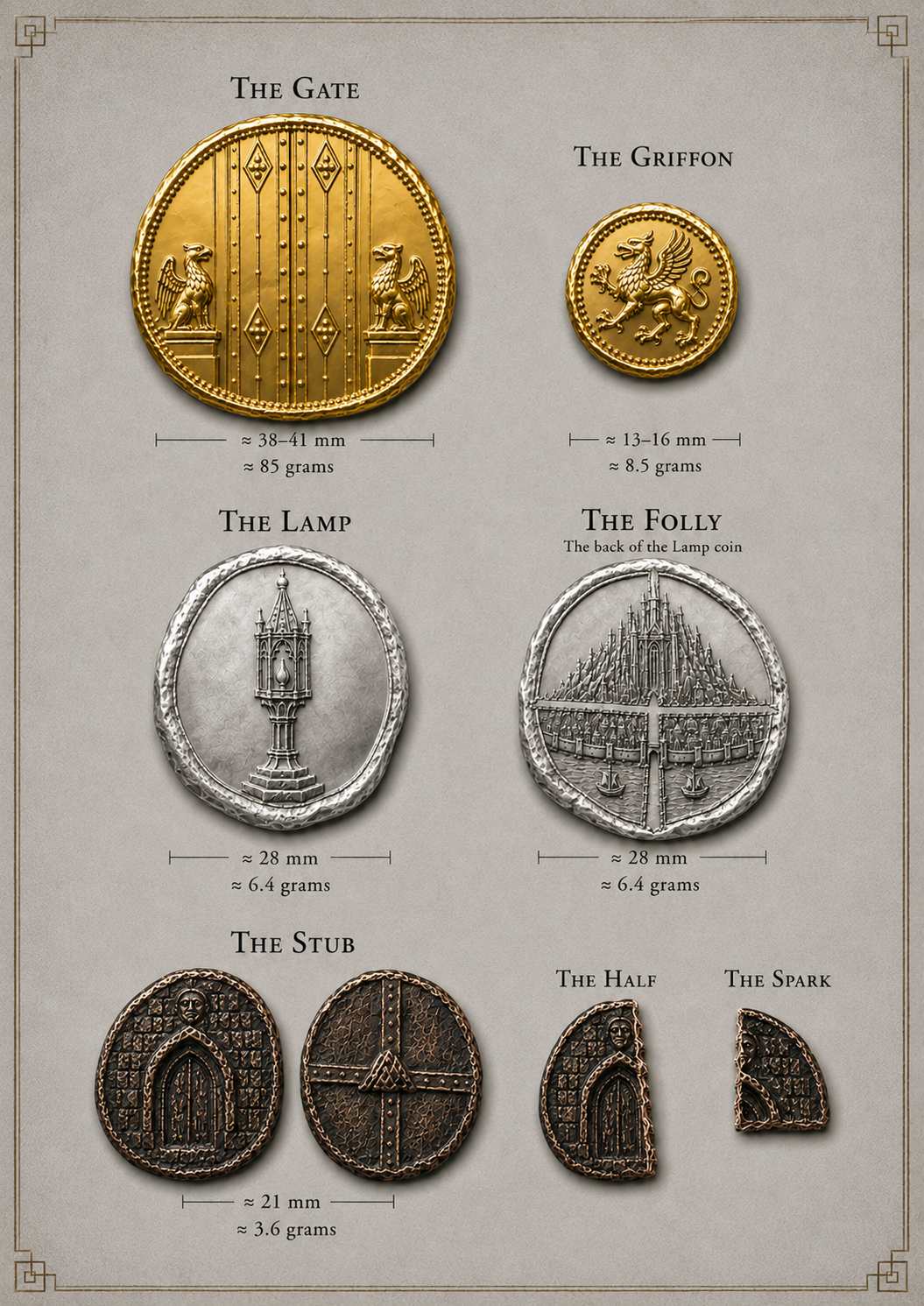
The lamp is the city's working coin. Wages, lodging, and gear are priced in lamps; a laborer earns two a day. The stub is street money, black with wear. It spends at face in the city and Grounds, but for half or nothing in the border countries. Griffons are merchants' money, bitten and weighed before acceptance. Gates pay for ships, shopfronts, and dowries, though most exist only in counting-house ledgers. The wagon-penny is a one-lamp toll on a laden wagon. The coin that gave the toll its name is gone, but the Pantry keeps the term.
Every Pantry coin bears the same reverse: four roads running from the central mountain to the edge, crossing a ring of raised dots just inside the rim. The dots are the lamps of the Grounds, and they deter clipping. Shears cannot shave the rim without cutting a lamp, and only the mint can restore one. The counter rejects any coin with a broken ring.
Sparks and halves are cut from stubs along the roads, the only lawful way to cut a coin. Each piece keeps part of the ring, and its straight edges follow visible roads. The scale still has the final word. Border-country money is changed for a fee of one part in forty. Old coins also come down with the plate: purses from guests a thousand years gone, stamped with the faces of lands that do not exist, or never existed here. The counter buys them by weight. Parterre collectors pay more for the strangest pieces.
3.7 The Mountain Trade
Folly's law does not recognize treasure-hunting. It treats goods above the first landing as estates whose owners are presumed departed. A registered expedition administers an estate: the climb-tithe pays its duty to the house, and the administrator receives title to the rest. Border-country lawyers call this the world's grandest legal fiction. The Ushers reply that no better law exists for the mountain's contents, and no heir has come forward in a thousand years.
Below the first landing, the law changes because the house does. The ground floor is still kept. Its sideboards are laid each morning, and their food is hospitality, not an abandoned estate. Nothing there can be salvaged. Stripping its furnishings is simple theft.
Only the Provisioners, eldest of the great companies, may carry out food. Their charter licenses them to fetch, never to take. Member companies visit reliable rooms on posted schedules and sell what they bring down from guild barrows and cellars. Handcarts reach every market by morning. Taprooms serve the house's wine and ale the day it is drawn. Yearly charter-rent to the Pantry replaces the tithe.
The monopoly comes with duties: fixed prices, a day's-end dole of food that will not keep, and good conduct in the rooms. The Provisioners police their crews more fiercely than any Usher could, since their trade depends on the house continuing to tolerate them. Provisions pass the Wicket under the Provisioners' badge or not at all. The Doorwatch punishes unlicensed foraging, though the queue's long memory usually does the watching. Registered climbers may eat at the house's tables on their way upstairs, an old custom the Provisioners have failed to end. On the way down, their packs are declared like everything else.
A registered climb is a journey past the first landing. The procedure is simpler than its legal doctrine, and every company learns it before its first ascent:
- Register the climb. Before going up, a company files its names, wills, and articles at the Pantry's counter. Registration costs a lamp a head and makes the climb lawful.
- Declare on return. Everything brought down the Wicket is declared at the same counter and weighed.
- Pay the tithe. The Pantry takes one part in ten of what came from past the first landing, in coin or in kind. The climb-tithe pays the Doorwatch.
- Take title. What clears the tithe belongs to the company, and the Doorcourt will enforce that title against anyone.
Treasure slipped past the Porter saves the tenth and risks the rest. Smugglers have no title, no standing at the Doorcourt, and only the Maze's fences, who pay a third below market on a good day. A first offense strikes a company from the register. Repeated offenses get its officers shown out.
The counter pays mint weight for plain gold and silver, face value for old coin that rings true, and market price for goods the Pantry can resell. Named or curious pieces go to open bidding on the hiring steps, where the institutions buy most of them. One rule predates every Pantler who has enforced it: nothing bearing the house's mark may be melted. The Pantry buys marked plate at full weight and warehouses it. No law explains the rule. No one breaks it.
The trade divides by floor. Pantry-runs to reliable ground-floor rooms pay wages: 3 to 5 lamps a day, a miner's pay for a miner's risk. Upper floors pay in shares or nothing. The articles posted on the hiring steps are so uniform that the Doorcourt treats them as custom: one full share for each sworn climber, a half-share for a hired porter who passes the first landing, and the company's third off the top for outfitting, widows, and wills. A good pantry-run makes a living. A good climb makes a company. The proverb covers the rest.
3.8 The Larder and the Ledger
The mountain is the world's richest larder, but its food does not keep. What the house lays, it lays for one day. Warm sideboard bread becomes sawdust by the next morning. Wine from the undying casks turns before the next noon. No Provisioner has preserved either. Thus the mountain feeds Folly breakfast, while the Grounds supply everything that must last: flour, salt meat, cheese, preserves, and winter casks. The two trades meet in the Orchard's markets and have never forgiven each other.
For a traveler with a purse, the rules are short:
| Purchase | The rule in Folly |
|---|---|
| House food and drink | half price or less; a house loaf costs 1 stub in the morning and mere sparks by lamplighting; after dark, the Provisioners give away the remainder, as their charter requires |
| Provisions that keep | full market rates; the Pantry watches the grain price the way other cities watch their walls |
| Beds | 2 lamps for a private room in the Gateyards, 1 in the Fountain Court, a few stubs in the Maze, or free on the Lawns if you own a tent |
| Work of the Offices | porcelain, linen, brass, and lampwork; the finest made anywhere, and priced accordingly |
| Adventuring gear | everything at fair rates; every outfitter in the Manse sells within sight of the hiring steps, and an overcharged quartermaster never returns |
The streets reckon in stubs and sparks, the trades in lamps, and the Parterre in griffons and gates. City debts run from hinge day to hinge day. The week after the Quenching is the great settling: board arrives, accounts close, and counting houses stay open after the markets shut. For one part in fifty plus the cost of proving the seal, those houses issue letters of credit honored by their border-country correspondents. In the Grounds and on the roads, carry coin. The Pantry neither lends nor borrows. It has never needed to, a fact the counting houses prefer not to examine.
4. The Powers of the Manse
Folly is the world's largest city, but most of the world has never heard its Noon Dark bells. The city's household customs weaken with every mile of road. Three days out, the lamps and the Grounds end. A week out, "the house" is something merchants swear by rather than live in. A month out, nations speak their own tongues, worship their own gods, and dispute who owns the Manse.
Over a thousand years, Housebound settlers have spread down the roads, Drawn travelers have arrived with foreign arts and old grudges, and Borderfolk have crossed the Walls. They have raised powers that owe Folly nothing. This chapter surveys the greatest of them, using the names known along the roads.
4.1 Vane
Weeks earthward of Folly, the quarry country rises toward the Gravenwall. There lies Vane, the world's proudest kingdom and the only one whose name makes a legal claim. Its aristocracy, the Blood, keeps genealogies tracing each family back a thousand years to the Founder and the first Guests. Their doctrine is simple: the Manse is an inheritance, the Blood are its heirs, and the Folly is theirs by right.
Vane calls itself a kingdom but has no king. Its throne will remain empty until the royal line regains its inheritance. A Regency of the Blood has ruled for nine centuries.
The people of Vane call themselves Vanic. The rest of the world says Vanish, an old insult the court has never managed to correct.
4.1.1 The Withdrawal
Early in Folly's history, several families claimed the mountain and lost. What happened next depends on which city tells the story. Folly's histories say the Doorcourt passed its greatest sentence and showed the claimants out. Vane's histories say free heirs cannot be expelled from their own estate. The families withdrew in protest, refusing to live as guests in their own house. The two accounts have never been reconciled.
Both cities agree on what came next. The exiles marched earthward, chose ground in the quarry country, and began to build. Their principle became Vane's national character: what your own hands build is unquestionably yours. They used no found walls, inherited magic, or self-laying sideboards. They quarried the stone and raised the city themselves.
4.1.2 The Ring and the Name
Vane's founding relic is a heavy gold signet ring taken from the mountain's first floor. Its device has worn past recognition. The kingdom's name comes not from the ring but from the wax. The Blood holds a few first-century documents sealed with it. Around each impression's rim appears one clear word: VANE, with broken wax on either side.
Court doctrine says the breaks mark a decorative border and the name is complete. Foreign scholars note that the letters might be part of a longer word. Asking what may be missing is called reading the border. In Vane, it is blasphemy.
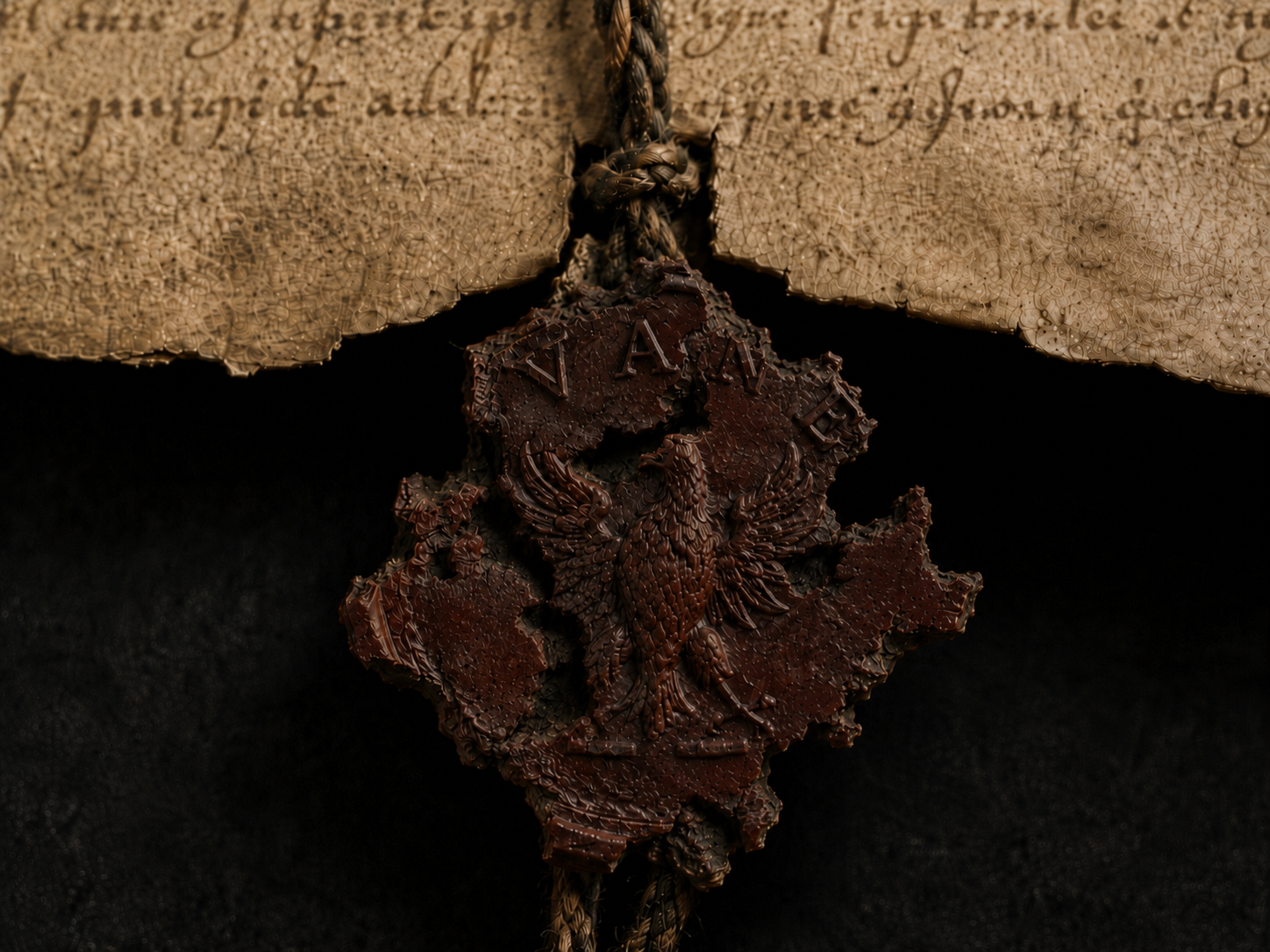
The worn device deepens the dispute. The College of Rolls calls it an eagle displayed, wings raised, and that eagle adorns every banner, coin, and gatepost in the realm. The oldest impressions show a plainer bird standing on a pivot. The mansion's rooftops carry weathercocks. Rival courts ask cock or eagle? whenever grandeur may hide common origins. In Vane, the phrase is grounds for a duel.
4.1.3 Dravenna
The capital's name is not common speech. The Blood claims to preserve the Founder's own tongue, a high language taught only to the great families and the College of Rolls. The spell of shelter was supposedly cast in this language. It names the city Dravenna, which the court translates as the carved seat.
Dravenna is everything Folly is not: planned, orderly, built to human scale, and proud of it. It is a city of gray granite and famous glass, where the building trades form a second aristocracy and a cathedral-builder's patience is the national virtue. Construction magic is low work, almost shameful. Not one conjured stone is both the city's boast and its building code. Vane dates documents from the laying of Dravenna's First Stone, not the Founding.
At the center stands Vanehall, seat of the royal line and the finest handmade building in the world. It is deliberately unfinished. One wing has stood open to the sky for nine hundred years: scaffolded and worked, but never closed. Vanehall is officially a residence in exile, and finishing it would admit that exile is permanent. The Unfinished Wing is the national symbol, the oath of Vanish soldiers, and the source of a Manse-wide phrase for any endless project: waiting for the roof.
4.1.4 The Blood and the Rolls
Rank in Vane depends on descent from the Founder and first Guests. The College of Rolls, the herald-genealogists who wield the realm's true power, calculates that descent by degrees. A single finding can raise or ruin a family. Pedigree research is warfare, and marriage merges rival claims. Archivists are courted, bribed, and sometimes killed for what they know.
Vane's law rests on the Entail: the Manse cannot be sold, granted, or given, only inherited, and the Blood are its heirs. From this doctrine comes the realm's most provocative custom. The Rolls issue paper deeds to parts of the mountain. A magnate's proudest possession may be his family's title to the East Galleries or the Third Landing Stair.
Folly's courts do not recognize these deeds. Still, every deed demands an inventory, so Vanish lords sponsor expeditions to survey their holdings. The companies register at the Wicket and pay the tithe like any other, though always under protest and with a ritual formula. They map, mark, and catalogue the claimed estate. The pay is good, the orders precise, and the work deeply political.
4.1.5 Vane and the Mountain
Vane keeps no embassy in Folly; an embassy would recognize the government it disputes. Instead, a resident Bailiff of Folly formally serves the city an annual writ of ejectment on behalf of the rightful heirs. The Ushers receive the writ, thank the Bailiff, and decline it. This exchange has continued for centuries, and both cities file every writ.
Vanish nobles come of age by treading the hall. They enter the Wicket, walk to the first landing, touch the stone, and return. The Porter watches them as it watches everyone. In nine hundred years, the house has never treated the Blood differently from any other guest. Vane's doctrine cannot explain this. The Vanish proverb is the linen does not bow.
Vane trades stone, ore, and engineering with the Delvers' Compact, which famously does not care who owns the surface. It marries into the middle kingdoms, hires khanate outriders for its caravans, and funds more registered climbs than any other patron. Vanish travelers in Folly refuse house food and buy from the Grounds' markets. At home the question never arises; nothing from the house's tables lasts long enough to reach Vane.
4.2 The Powers Beyond
This is the rest of the map as Folly's counting houses record it. The names below were coined by carters and clerks. Each power calls itself something else, and most deserve more than this brief survey.
4.2.1 The Middle Kingdoms
The deep interior between the great roads holds more crowns than any Folly clerk counts: at least a dozen realms, grown from the river fords and road towns of the first centuries. Barons, tithes, tourneys, shrines, and formal border feuds fill their politics. In most, the Folly is a distant rumor. The world's stranger wonders appear rarely and are remembered for generations.
Four crowns dominate. Bredon is the oldest; its kings are crowned barefoot in the ford crossed by its first bridge. Cantlow, realm of a hundred shrines, hosts a Church of the Far Gods more powerful than its crown. Merrowmere holds the quiet lake country, and its laws are proclaimed from a boat. Dunmow, smallest and best fed, has crowned halfling rulers for eleven generations. Marriages reshape the lesser realms so often that only their heralds keep a full tally.
Most people in the Manse live in the middle kingdoms, many of them halflings. Halfling communities fill the deep interior's shires and Folly's market gardens. Some families have farmed the same bottomland since the first roads were laid.
4.2.2 The Delvers' Compact
This mining nation binds dwarven holds, human quarry-towns, and steadings of living stone folk beneath one treaty. Below an agreed depth, it negotiates every claim by the yard. Dwarves form the Compact's heart, while rock gnomes serve as surveyors and engine-wrights. Its loremasters will not say whether the dwarves are Drawn or descend from a member of the Founder's company. The Compact sells stone, ore, and engineering to anyone and avoids the surface powers' disputes. Recently, it stopped selling depth-maps. It will not say why.
4.2.3 The Vigil Wood
Elves hold the world's great forest. This long-lived Drawn people arrived centuries ago, fleeing something across the planes. Their whole culture now stands watch against its arrival. They kill trespassers by protocol, not malice. Their diplomats always sit facing the door. Lately, their border beacons burn more often.
4.2.4 The Grass Khanates
The khanates began with horses. The Founding left the world's herds masterless, and they ran wild for generations before anyone followed. The first khans were drovers and drifters, both Housebound and air Borderfolk, who learned to ride the old blood. A horse descended from those herds still bears the only pedigree a khan respects. As the border countries widen, new grass opens faster than settled powers can claim it. The khanates have always followed it outward.
They guard caravans for a price and raid those that refuse to pay. Their faith is the open sky, and they see the two night glows as their ancestors' campfires. They alone command the fireward routes across the ash country. No caravan reaches the stranded city without a khanate escort, and those fees support every khan. For the first time in living memory, one khan is uniting the banners.
4.2.5 The Jarldoms of the Drowned Coast
These sea-country raider-traders descend from stranded fleets and water Borderfolk. They raid during the drowned half and trade during the ember half. They set their dead adrift toward a great whirlpool, which their faith calls the door to the next world. Sometimes a funeral ship returns.
4.2.6 The Uninvited Kingdom
Four centuries ago, a vast mis-teleport carried two peoples in mid-exodus to unclaimed grassland. The goblins stopped. They never asked to come and were never asked to stay. Now they form a settled realm, legitimate by every law the settled powers recognize, and keep the world's only standing army. It has never marched. The two peoples who arrived together do not discuss each other with outsiders.
4.2.7 The Orc Warbands
The orcs arrived with the goblins but never accepted that the exodus had ended. They have no nation, only warbands: a migration under arms that has circled the Dark Miles and the ash-country fringes for four hundred years, taking what it needs from roads and marches. Warlords rise by claiming to know the way home and fall when they fail to find it. Only a warlord powerful enough to unite many bands can drive the middle kingdoms and khanates into alliance. No orc has told an outsider what the exodus fled.
4.2.8 The Stranded City
Deep in the ash country beneath the Hearthwall lies the great arrival-ground, where the Manse's wild magic drops most of what it catches. Upon it stands the stranded city, the only inhabited place in the world's harshest country. Every wizard in its ruling magocracy arrived by accident.
The city survives because its founders were powerful. Rather than die in the ash, the first stranded wizards and priests drove wells to deep water flowing from the Weepingwall, on the world's far side. They layered sheets of shading magic above the city and its gardens to shield them from the fireward glare. This standing twilight is visible a day's ride away.
The shade and wells are the basis of government. The colleges that maintain them rule the city, and gnome illusionists have sat among their masters since the beginning.
Its first industry was departure: maps, rituals, and expeditions toward the Walls. None succeeded. Its present industry is the arrival-ground. Everything new, dangerous, and unpriced enters the world through its markets and leaves by khanate caravan.
4.2.9 The Church of the Far Gods
The largest faith in the Manse came with the Drawn. This missionary church serves gods who did not make this world and have never been seen within it. The church teaches that their power crosses even the Walls. Its proof is simple: prayers are answered. It discourages questions about what answers them.
Campaign material for a private table. AD&D and Dungeons & Dragons are trademarks of their respective owners.